

BCI-BASED NEUROREHABILITATION FOR CLINICAL PRACTICE
Turn brain activity into real-time rehabilitation feedback.
recoveriX PRO combines EEG-based motor imagery detection, real-time neurofeedback, and functional electrical stimulation (FES) in one integrated neurorehabilitation system. Designed for therapists, hospitals, and rehabilitation centers, recoveriX PRO enables structured, personalized motor training supported by objective brain activity monitoring.


COMPLETE BCI-BASED NEUROREHABILITATION SOLUTION
recoveriX by g.tec medical engineering is an EEG-based, closed-loop neurorehabilitation system designed to support motor rehabilitation in patients with neurological impairments. It combines brain-computer interface technology, motor imagery, visual feedback, and functional electrical stimulation (FES) in a structured, therapist-guided training program.
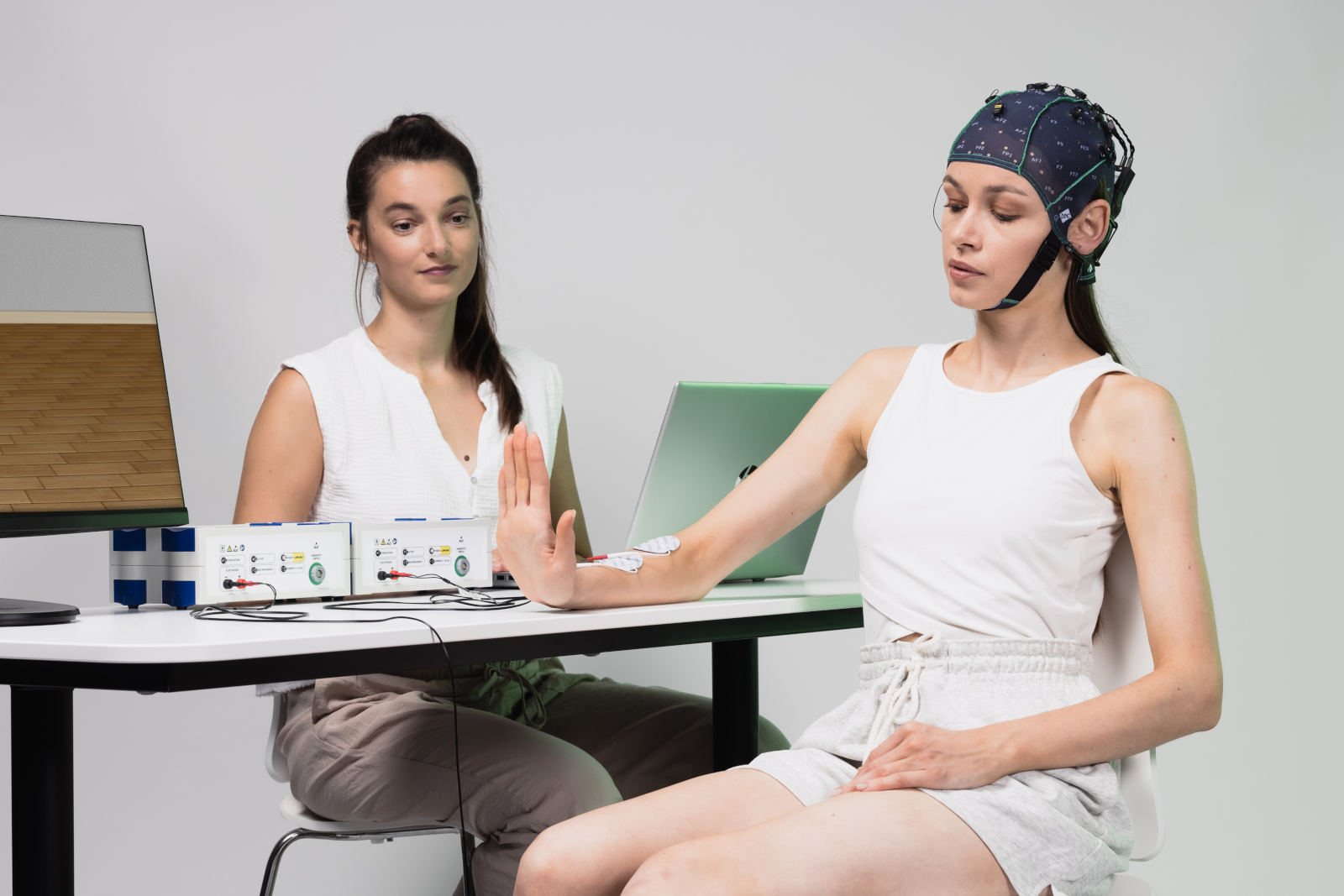
During therapy, patients imagine specific hand or foot movements while recoveriX analyzes their brain activity in real time. When the system detects the corresponding motor imagery pattern, a virtual avatar provides visual feedback and functional electrical stimulation activates the targeted muscles, linking the patient’s intention to move with sensory and motor feedback.
This approach is designed to engage sensorimotor networks and support activity-dependent neuroplasticity. Published clinical studies have investigated recoveriX in stroke and multiple sclerosis rehabilitation, reporting improvements in motor function and mobility.
| Closed-Loop BCI Neurorehabilitation | Combines EEG-based motor imagery detection with real-time visual and functional electrical stimulation feedback. |
| Upper-Limb Rehabilitation | Structured hand and wrist motor imagery training for patients with motor impairments. |
| Lower-Limb Training | Foot and ankle motor imagery training, with clinical or research availability depending on the system configuration and intended use. |
| Real-Time Neurofeedback | A virtual avatar visualizes the intended movement while FES provides corresponding physical feedback. |
| Patient Performance Monitoring | Classification accuracy and real-time event-related desynchronization (ERD) maps provide information about motor imagery performance. |
| EEG Signal Quality Control | Online EEG quality monitoring supports electrode setup and signal assessment during therapy. |
| Guided Therapy Sessions | Structured motor imagery tasks and patient instructions support consistent therapy delivery. |
| Therapist-Guided Rehabilitation | Designed for integration into supervised neurological rehabilitation programs in hospitals and rehabilitation centers. |
| Clinical Research Evidence | Published studies investigate upper-limb stroke rehabilitation and mobility outcomes in multiple sclerosis. |
| Medical Device Configuration | CE-marked configurations are available, subject to the applicable intended use and regional regulatory requirements. |
| Rehabilitation Technology | EEG-based brain-computer interface (BCI) with real-time neurofeedback |
| Therapy Approach | Motor imagery combined with visual feedback and functional electrical stimulation (FES) |
| Clinical Application | Upper-limb motor rehabilitation following stroke |
| Training Options | Hand and wrist training; lower-limb training subject to regional indications and research licensing |
| Personalized Therapy | Individual EEG calibration adapts training to each patient's brain activity |
| Motor Imagery Detection | Real-time EEG classification |
| EEG Recording | Wireless 16-channel EEG headset |
| Visual Feedback | Interactive virtual avatar showing hand or foot movements |
| Physical Feedback | Two functional electrical stimulators providing muscle activation |
| Therapy Sessions | Three training runs comprising 240 motor imagery trials |
| Patient Progress Monitoring | Motor imagery performance, brain activation patterns, and session results |
| Therapist Interface | Guided therapy software with real-time EEG quality monitoring |
| System Components | Therapy computer, patient display, EEG headset, stimulation devices, electrodes, and software |
| Professional Use | Operated by trained healthcare professionals in supervised rehabilitation settings |
| Medical Device Status | CE-marked medical device; clinical indications depend on the country |
ADVANCED NEUROTECHNOLOGY. SIMPLIFIED FOR CLINICAL PRACTICE.
One integrated system. Multiple rehabilitation technologies.
recoveriX PRO brings together a wireless 16-channel EEG system, functional electrical stimulation, real-time visual feedback, and intuitive therapy software.
Patient-specific EEG calibration, guided exercises, and automated performance analysis support structured rehabilitation sessions without requiring therapists to manage multiple independent systems.


OBJECTIVE MONITORING OF MOTOR IMAGERY PERFORMANCE
See what conventional observation cannot reveal.
Motor imagery takes place inside the brain and cannot be reliably assessed through observation alone.
recoveriX PRO analyzes EEG activity in real time, allowing therapists to monitor motor imagery classification accuracy, brain activation patterns, and EEG signal quality.
This provides objective information about patient performance throughout therapy and helps therapists deliver individualized training.
EXPAND YOUR PRIVATE REHABILITATION PRACTICE
Differentiate your practice with advanced BCI-based neurorehabilitation.
Bring recoveriX into your neurological rehabilitation practice and offer patients an innovative, technology-assisted approach to motor recovery after stroke.
By combining motor imagery, real-time neurofeedback, and functional electrical stimulation, recoveriX enables you to expand your treatment portfolio and complement conventional rehabilitation methods.
Invest in your own recoveriX system, establish your practice as a regional provider of BCI-based neurorehabilitation, and create new opportunities for patient care and business growth.

ADVANCE REHABILITATION IN HOSPITALS & REHABILITATION CENTERS
Integrate BCI-based neurorehabilitation into your clinical programs.
Expand your rehabilitation services with recoveriX, a complete neurorehabilitation system designed for supervised, therapist-guided motor training.
Combining EEG-based motor imagery detection, real-time neurofeedback, and functional electrical stimulation, recoveriX complements conventional physiotherapy and occupational therapy while providing objective monitoring of patient performance.
Equip your rehabilitation department with advanced neurotechnology and offer personalized, structured training for eligible stroke patients across appropriate stages of recovery.
MOTOR IMAGERY
Patients imagine specific hand or foot movements without having to perform them voluntarily. recoveriX detects motor imagery-related EEG patterns and uses this brain activity to control feedback in real time.
VIRTUAL REALITY & VISUAL FEEDBACK
A virtual avatar displays the intended movements from the patient’s perspective. Visual feedback is synchronized with electrical stimulation, helping patients connect imagined movements with observable outcomes.
FUNCTIONAL ELECTRICAL STIMULATION
Functional electrical stimulation (FES) activates targeted muscles to produce wrist or ankle dorsiflexion. During BCI-controlled training, stimulation is triggered when the system detects the corresponding motor imagery pattern.
VISUAL ACTION OBSERVATION
Patients observe movements performed by a virtual avatar while engaging in motor imagery. This combines visual action observation with active mental practice to support sensorimotor engagement.
BILATERAL TRAINING
Patients practice motor imagery involving both the affected and unaffected sides of the body. Alternating between left- and right-sided tasks encourages engagement of motor-related brain networks in both hemispheres.
PERSONALIZED NEUROFEEDBACK
recoveriX calibrates its EEG classifier to each patient’s individual brain activity. During training, visual and electrical feedback is linked to detected motor imagery patterns, reinforcing task-related engagement.
TASK-BASED TRAINING
Structured exercises guide patients through repeated motor imagery tasks with synchronized feedback. Interactive visual exercises provide additional opportunities for engagement during rehabilitation.
NEUROLOGIST EXPLAINS RECOVERIX THERAPY FOR STROKE & MS
Can patients improve motor function even years after a stroke? And how can BCI-based neurorehabilitation support people living with multiple sclerosis? In this interview, neurologist Dr. Tim von Oertzen shares five years of outpatient experience with recoveriX neurorehabilitation therapy. He explains how motor imagery, real-time neurofeedback, and functional electrical stimulation work together to support neurological rehabilitation.
Drawing on his clinical practice, he discusses improvements observed in walking, hand function, everyday independence, and MS-related fatigue. He also addresses patient eligibility, scientific evidence, and why rehabilitation may remain relevant long after the initial neurological event.

CLINICAL IMPROVEMENT FROM THE MS STUDY
A group study showed that recoveriX was effective for upper and lower limb treatment. Multiple Sclerosis patients improved in standing up and sitting down, balance, walking speed, walking distance, spasticity, MS impact and fatigue. The improvement in fatigue is especially interesting because there is no other treatment available.

CLINICAL IMPROVEMENT IN THE LOWER EXTREMITY AFTER STROKE TREATMENT

The efficacy of recoveriX lower extremity treatment was shown in a group study with chronic stroke patients. recoveriX patients improved their walking speed on average by 0.19 m/s. The best other treatment option (electromechanical gait training with end effector training) led to 0.11 m/s improvement. Importantly, recoveriX is easier to use and does not need a body weight support system because patients are seated during the recoveriX therapy.
CLINICAL IMPROVEMENT IN THE UPPER EXTREMITY AFTER STROKE TREATMENT

The efficacy of recoveriX upper extremity treatment was shown in a group study with chronic stroke patients. Patients could move their upper extremities better after treatment. The improvement depended on the stroke severity but was always above the clinically important difference. The recoveriX therapy works even 10, 20 or 30 years after the stroke.
SCIENTIFIC EVIDENCE FOR BCI-BASED NEUROREHABILITATION

BCI-FES Improves Stroke Recovery
A 2024 meta-analysis published in Frontiers in Human Neuroscience evaluated the effectiveness of BCI-controlled functional electrical stimulation (FES) for upper-limb rehabilitation after stroke. The results demonstrated significant improvements in motor function compared with control interventions. Benefits were observed in both subacute and chronic stroke patients.
- 290 patients across 10 randomized controlled trials
- Significant motor improvement: SMD = 0.50 (p < 0.0001)
- Effective in subacute and chronic stroke: Significant improvements in both groups

BCI Enhances Motor Recovery
A 2020 meta-analysis published in BMC Neurology investigated EEG-based BCI training using motor imagery for stroke rehabilitation. The findings showed that adding BCI training to conventional rehabilitation improved upper-limb motor function. The analysis also identified significant improvements in measures of brain function.
- 362 patients across 14 clinical studies
- Upper-limb motor recovery: SMD = 0.39
- Brain function improvement: SMD = 1.11

BCI-FES Shows Strong Results
A 2020 meta-analysis published in the Journal of NeuroEngineering and Rehabilitation investigated BCI-based upper-limb rehabilitation after stroke. BCI training significantly improved motor function compared with control interventions. The combination of BCI and functional electrical stimulation (FES) showed particularly promising results.
- 313 patients across 12 controlled studies in the pooled immediate-effect analysis
- Significant motor improvement: SMD = 0.42 (p < 0.001)
- BCI combined with FES: SMD = 1.04 in subgroup analysis
SEE RECOVERIX PRO IN ACTION
From system setup to a complete BCI neurorehabilitation session. Discover how recoveriX PRO integrates into clinical rehabilitation workflows in this hands-on demonstration. Follow the complete process, from preparing the wireless EEG headset and functional electrical stimulation to guiding patients through motor imagery training with real-time neurofeedback.
See how therapists calibrate the system, monitor brain activity, and track patient performance throughout structured rehabilitation sessions.

IMPROVING GAIT REHABILITATION WITH BCI
Explore how recoveriX supports lower-limb motor training after stroke. Discover how EEG-based motor imagery, real-time neurofeedback, and functional electrical stimulation are combined to train ankle movement and address gait impairments following stroke.
This expert presentation explains the recoveriX lower-limb training protocol, demonstrates how therapy sessions are conducted, and explores clinical research findings on walking speed and functional mobility. See patient examples, learn how rehabilitation outcomes are assessed, and explore the potential of BCI technology for stroke gait rehabilitation.

REAL PATIENTS. MEASURABLE PROGRESS.
Explore stroke rehabilitation results with recoveriX. Discover how BCI-based neurorehabilitation is being used to support motor recovery after stroke, including in patients who begin training months or years after their stroke.
Through real patient stories, before-and-after demonstrations, and standardized clinical assessments, this presentation explores changes in hand function, fine motor skills, and everyday activities following recoveriX training.
Learn how motor imagery, real-time neurofeedback, and functional electrical stimulation work together, and see how patient progress is evaluated using established rehabilitation assessments.

CLINICAL RESULTS IN STROKE & MS REHABILITATION
Explore real patient outcomes and the science behind BCI-based neurorehabilitation. Discover how recoveriX combines motor imagery, real-time neurofeedback, and functional electrical stimulation to support research into motor recovery after stroke and in people with multiple sclerosis.
This expert presentation explores clinical findings, standardized rehabilitation assessments, and before-and-after patient examples involving hand function, walking performance, and mobility. See how researchers evaluate treatment outcomes and investigate the potential of BCI-based training for upper- and lower-limb rehabilitation.

FREQUENTLY ASKED QUESTIONS
A significant disorder in language, cognition, and/or attention (such as Wernicke’s aphasia or dementia), which prevents the patient from understanding the tasks and/or performing these tasks, is an exclusion criterion.
The recoveriX treatment can also be used for patients with epilepsy, but the final decision is done by your family doctor.
Patients do not need a separate therapy session for the instruction – they can start with the therapy immediately. The patients only need to learn the general procedure and simple instructions for the therapy session before the first session. The first session is already part of the therapy.
recoveriX provides functional muscle stimulation of the left and right arm to perform a dorsiflexion and of the left or right foot. This improves lower and upper limb functions.
Yes. Actually, recoveriX combines 3 standard therapies into one treatment: (i) functional electrical stimulation, (ii) motor imagery and (iii) mirror neuron therapy. Additional physical therapy can be beneficial for the patient.
recoveriX can be used for stroke rehabilitation across the acute, sub-acute, and chronic stages, as various patient cases have shown. Our scientific study has shown that recoverX therapy is effective even 10, 20, 30,… years after the stroke or neurological disorder occured.
It is recommended to perform recoveriX therapy for a complete course of 25 therapy sessions, with 3 sessions per week, each lasting for about 1 hour. Of course, it is also possible to participate in other therapies or rehabilitation programs. We know that patients are likely to improve more, the more therapy he/she gets.
Yes, the improvements are long-lasting and remain permanently.
One recoveriX block contains 25 therapies. 3 therapy sessions per week are recommended. Patients can have up to 2 treatments per day. This is especially useful to reduce exhausting travel time.
recoveriX is a rehabilitation system specifically developed for patients with neurological deficits. Patients who had a stroke, a traumatic brain injury or another brain injury can do the therpay. Furthermore, patients with hemiplegia, movement impairments resulting from brain damage, pain, spasticity or Multiple Sklerosis can benefit from the therapy.


NEED MORE INFORMATION
ABOUT THIS PRODUCT?
Send us your email so we can contact you as soon as possible.


