


DETECT EVERY STIMULUS & SYNCHRONIZE EVERY EVENT
Precisely detect external stimulation events and synchronize them with EEG, BCI, and electrophysiological recordings. The g.TRIGbox converts visual, auditory, tactile, and digital input signals into reliable, bounce-free trigger pulses, allowing researchers to capture stimulus timing directly from external devices.
With four independent trigger channels, adjustable detection thresholds, 4 kV input/output isolation, and both 5 V TTL and 200 mV trigger outputs, g.TRIGbox integrates a wide range of stimulus sources with compatible data acquisition systems, including g.HIamp, g.USBamp, and g.Nautilus.
From screen-based ERP experiments to auditory and multimodal stimulation paradigms, g.TRIGbox helps researchers achieve consistent event marking without requiring dedicated trigger-generation software.
| Multimodal Trigger Detection | Detect visual, auditory, tactile, and digital events from external stimulation sources. |
| 4 Independent Trigger Channels | Monitor four trigger sources with individually adjustable detection thresholds. |
| Optical Event Detection | Detect actual screen changes, LED flashes, and other visual events using phototransistor sensors. |
| Low-Level Analog Inputs | Detect signals from microphones, piezoelectric sensors, inductive sensors, and audio outputs. |
| Digital & High-Level Inputs | Accept compatible TTL/CMOS signals, response buttons, and other external event sources. |
| Bounce-Free Trigger Pulses | Generate pulses of at least 20 ms for reliable event detection, including at lower acquisition sampling rates. |
| 4 kV Input/Output Isolation | Electrically isolate trigger inputs from outputs. |
| TTL & Analog Trigger Outputs | Connect to digital trigger inputs using 5 V TTL or suitable analog acquisition channels using 200 mV outputs. |
| 16 Encoded Trigger Combinations | Represent up to 16 combinations of the four trigger channels through one encoded analog output. |
| Flexible EEG Integration | Connect to compatible g.HIamp, g.USBamp, g.Nautilus, and other suitable acquisition systems. |
| Device Type | Multimodal trigger detection and pulse generation interface |
| Independent Trigger Channels | 4 |
| Low-Level Inputs | ±0.5 mV to ±200 mV |
| High-Level Inputs | ±100 mV to ±5 V |
| Optical Inputs | High-speed phototransistor sensors |
| Trigger Outputs | 4 individual trigger outputs |
| Digital Output Voltage | 5 V TTL |
| Analog Output Voltage | 200 mV |
| Trigger Pulse Duration | At least 20 ms |
| Encoded Output | 4-bit analog encoding, 16 possible combinations |
| Detection Thresholds | Individually adjustable per channel |
| Input/Output Isolation | 4 kV |
| Output Connector | 15-pin D-Sub |
| Power Supply | 9 V alkaline battery or optional safety power supply |
| Current Consumption | Less than 60 mA |
| Intended Use | Scientific research only; not a certified medical device |
PRECISE VISUAL STIMULUS DETECTION & ERP SYNCHRONIZATION
Accurate stimulus timing is essential for event-related potential (ERP), P300, and visual evoked potential (VEP) research. The g.TRIGbox uses high-speed optical sensors to detect actual changes in light intensity from computer screens, LEDs, flash lamps, and other visual sources.
By converting detected events into reliable trigger pulses, researchers can synchronize visual stimulation with EEG recordings, even when using standard presentation software such as PowerPoint. This helps avoid relying solely on software-generated event timestamps.


AUDITORY & MULTIMODAL TRIGGER DETECTION
The g.TRIGbox detects stimulus events from a wide range of external sources, including microphones, sound card outputs, piezoelectric and inductive sensors, pushbuttons, and TTL/CMOS signals.
With four independent trigger channels and individually adjustable detection thresholds, researchers can combine visual, auditory, tactile, and digital event sources within a single experimental setup. Low-level and high-level inputs provide flexible integration with existing stimulation equipment, without requiring a dedicated software interface.
EEG TRIGGER SYNCHRONIZATION & DATA ACQUISITION
The g.TRIGbox converts detected stimulus events into bounce-free trigger pulses with a minimum duration of 20 ms, enabling reliable event detection by compatible EEG acquisition systems.
With 5 V TTL and 200 mV trigger outputs, the device supports integration with digital trigger inputs or suitable analog recording channels, including those of g.HIamp, g.USBamp, and g.Nautilus. Its 4 kV input/output isolation provides electrical separation between stimulation equipment and the recording system.
For experiments involving multiple conditions, a 4-bit encoded analog output can represent up to 16 trigger combinations using a single acquisition channel.

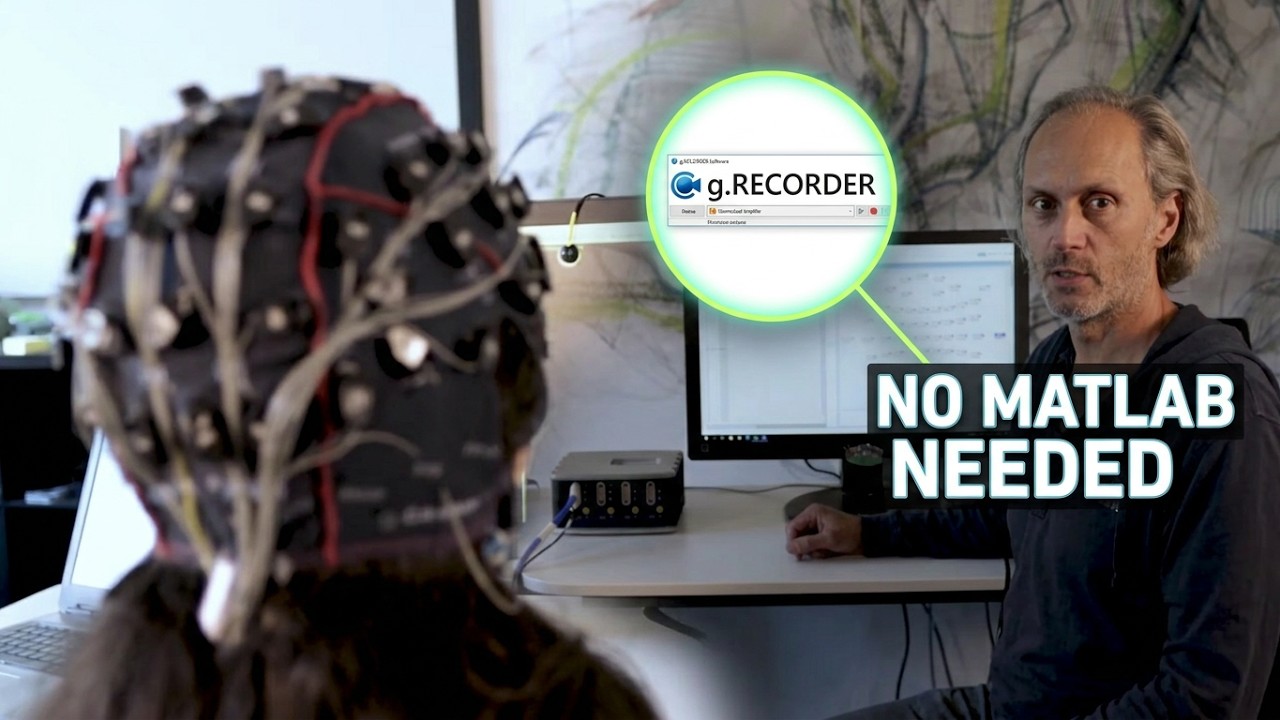
P300 & ERP EXPERIMENTS WITH OPTICAL TRIGGERS – NO MATLAB REQUIRED
See how optical stimulus detection enables precise EEG trigger synchronization and real-time P300 analysis using g.Recorder and a 64-channel g.HIamp EEG system. Two optical sensors attached to the presentation screen detect target and non-target visual stimuli, generating trigger signals that are recorded alongside EEG data.
Without requiring MATLAB, g.Recorder automatically calculates and visualizes event-related potentials (ERPs) in real time, including topographic brain maps and characteristic P300 responses approximately 300 milliseconds after target presentation.
FREQUENTLY ASKED QUESTONS
Yes. g.TRIGbox can generate hardware triggers from visual changes detected by optical sensors, independently of the software used to display the stimuli. Researchers can therefore build visual stimulation paradigms using software such as PowerPoint without requiring MATLAB to generate the trigger signals.
For example, optical sensors can detect target and non-target visual events during a P300 experiment. Their trigger signals can be recorded with EEG data using g.HIamp and g.Recorder, supporting real-time ERP averaging, topographic visualization, and analysis of stimulus-related brain responses.
Yes. g.TRIGbox provides 4 kV electrical isolation between its input and output lines, helping electrically separate external stimulus detection equipment from the EEG acquisition system.
The device can operate from a 9 V alkaline battery or an optional approved safety power supply. Third-party power supplies or chargers should not be substituted without manufacturer approval. g.TRIGbox is intended for scientific research and is not a certified medical device.
Yes. The four independent input channels can detect events from different external stimulation sources, such as a visual display, audio system, response button, or piezoelectric sensor. Each channel can be adjusted independently to detect its respective signal reliably.
This makes g.TRIGbox suitable for multimodal EEG, ERP, and BCI research, where events from different stimulus modalities need to be recorded in a common acquisition timeline. g.TRIGbox detects and marks external events; it does not itself generate or control the stimulation paradigms.
g.TRIGbox supports three input categories per trigger channel:
- Low-level analog inputs: ±0.5 mV to ±200 mV, suitable for signals from dynamic microphones, inductive sensors, piezoelectric sensors, and compatible audio outputs.
- High-level inputs: ±100 mV to ±5 V, including compatible pushbuttons and TTL/CMOS signals.
- Optical inputs: High-speed phototransistor sensors for detecting changes in light intensity.
Trigger outputs are available as 5 V TTL/CMOS signals and 200 mV analog signals, including individual and encoded output formats.
g.TRIGbox provides four independent trigger channels, each supporting low-level analog, high-level analog/digital, and optical input types. Each channel has an individually adjustable detection threshold and LED indicator.
In addition to individual trigger outputs, g.TRIGbox provides a 4-bit encoded analog output representing 16 possible combinations of the four trigger states. This allows multiple event combinations to be represented through a single compatible analog acquisition channel.
Yes, g.TRIGbox can be used in experiments involving these software environments because its trigger detection operates independently of the stimulus presentation software. It detects compatible physical optical, analog, or digital signals rather than requiring a software-specific interface.
For example, an optical sensor can detect a visual change generated by a PsychoPy or MATLAB paradigm and produce a hardware trigger. g.TRIGbox does not require a dedicated MATLAB toolbox, Python API, USB connection, or software driver for its documented trigger detection functions.
g.TRIGbox generates bounce-free trigger pulses with a minimum output duration of 20 ms to support detection even at relatively low acquisition sampling rates. However, this pulse duration must not be confused with trigger latency or timing jitter.
The published technical documentation does not specify a numerical stimulus-to-trigger delay, timing jitter, or synchronization accuracy in microseconds. Researchers requiring quantified timing performance for their experimental protocols should request validated measurements from g.tec.
Yes. g.TRIGbox supports high-speed optical phototransistor sensors that detect physical changes in light intensity on a display. This allows researchers to generate trigger events from actual visual stimulus changes rather than solely from software commands. This approach is particularly useful in visual ERP, P300, and VEP experiments, where the difference between a software event and the displayed stimulus can affect event alignment.
g.TRIGbox is designed for integration with g.HIamp, g.USBamp, and g.Nautilus EEG acquisition systems using a compatible trigger cable adapter. It provides individual 5 V TTL and 200 mV analog trigger outputs, as well as encoded outputs, through a 15-pin D-Sub connector. Integration with third-party EEG systems is possible when their electrical input specifications and connector requirements are compatible.
The g.TRIGbox is a multimodal hardware trigger detection interface that converts external stimulus events into bounce-free electrical trigger pulses. It detects optical changes on screens, audio signals, piezoelectric and inductive sensor signals, pushbutton events, and digital inputs. These pulses can be recorded alongside EEG data to identify when an external event occurred. Four independent trigger channels allow researchers to capture multiple event sources within a single experimental setup.
NEED MORE INFORMATION
ABOUT THIS PRODUCT?
Send us your email so we can contact you as soon as possible.


